
Driveways and lots from the East Bank to the Northshore
Asphalt Paving in New Orleans, LA
Paving designed for ground that sits low, settles slowly and gets more than 60 inches of rain a year.
- Free on-site estimates
- Written scope: base, thickness and drainage spelled out
- Permit questions answered before work is scheduled
Paving a City Built Below the Waterline
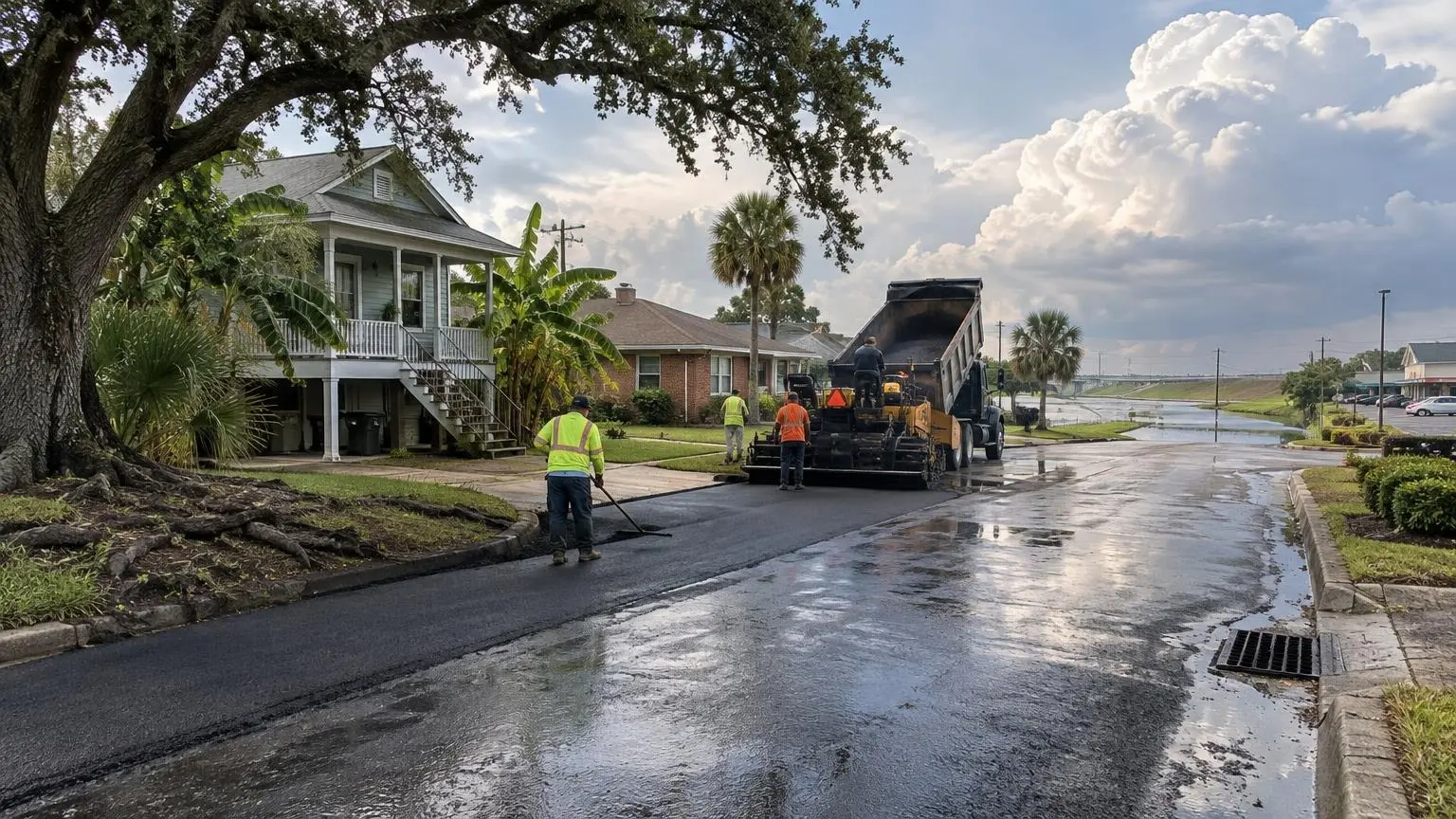
Asphalt paving in New Orleans starts with an unusual fact: most of the city is at or below sea level. A 2016 study in the Journal of Hydrologic Engineering found about 65 percent of New Orleans proper sits at or below mean sea level, and a Tulane and Xavier study put the average elevation at 1 to 2 feet below it. Parts of the city are also slowly sinking. Add rainfall of about 62 to 63 inches a year and you get pavement that lives on soft, wet ground. Driveways and lots here fail from below, so the base and the drainage get as much attention as the asphalt. Blacktop on that ground needs more stone under it than it would in most of the country.
Why pavement settles here
The first settlement was built on the natural levees along the Mississippi, the only high ground around. The city later spread into drained backswamp, where the soils are heavy river clays. The USDA describes backswamp clays such as the Sharkey series as poorly drained, very slowly permeable and 60 to 90 percent clay, and in most years they crack open 1 to 3 centimeters wide as they dry. Ground like that swells, shrinks and settles. Pavement over it needs a thicker compacted stone base, and sometimes a geotextile fabric to keep stone from pushing down into the mud.
Rain, not cold, is the enemy
New Orleans averages fewer than eight nights a year below freezing, so freeze-thaw damage is rare. The damage comes from water. Heavy summer downpours overwhelm low spots, water sits against pavement edges, and every open crack lets it into the base. We set slope on every job so water runs to the street drain or a planted area, not toward the house or into a corner of the lot.
Live oaks and roots
The same oaks that shade so many streets also lift pavement. Roots grow under asphalt because the ground below stays moist. Where a driveway passes near a large tree, we plan the route, the edges and the depth with the tree in mind, and we point out where roots will keep pushing.
Permits at the curb
In Orleans Parish, the City requires a Driveway or Curb Cut Permit to install, replace or repair a driveway that connects to a public street. The application fee is $100, and the site plan has to show nearby poles, hydrants, catch basins and trees. City standards cap a single-lane apron at 12 feet and a two-lane apron at 24 feet at the property line. Properties in historic districts may need Historic District Landmarks Commission or Vieux Carre Commission approval too. Jefferson Parish, Kenner and other jurisdictions have their own processes, and state highways go through Louisiana DOTD. We tell you which one applies before scheduling.
Front yards and stormwater
Most New Orleans neighborhoods do not allow more than 40 percent of a front yard to be paved under the zoning ordinance. Larger commercial projects with 5,000 square feet or more of impervious surface need a stormwater management plan that holds back and filters the first 1.25 inches of rain. Porous asphalt, which lets water pass through the surface into a stone reservoir, is one way to meet that. We cover it as its own service.
What a driveway job includes
- Measuring and checking slope, trees, drains and the apron
- Removing old pavement and hauling it off
- Digging out soft clay and building a thicker compacted stone base
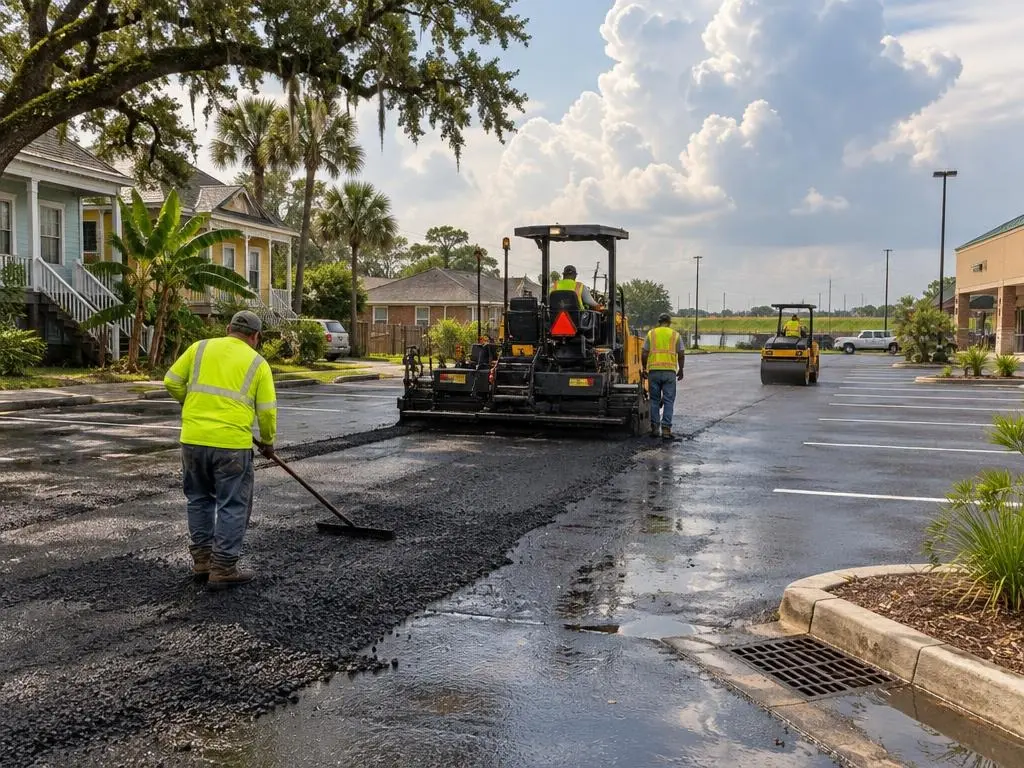
- Placing and rolling hot-mix asphalt to the thickness in your quote
- Clean joints at the garage slab, walkways and the concrete apron
- Guidance on cure time and when to seal
Our Services
Six services, from new driveways and lots to the sealing and repairs that keep them working.
Driveway Paving
Asphalt driveways rebuilt from the base up, sloped to drains and tied cleanly into the concrete apron.
Learn more →Parking Lot Paving
Commercial asphalt lots planned around traffic, drainage and the City's stormwater rules.
Learn more →Porous Asphalt Paving
Permeable asphalt that lets rain drain through to a stone reservoir instead of running off.
Learn more →Sealcoating
Sealer that protects asphalt from sun, rain and oil, applied between storms on cured pavement.
Learn more →Asphalt Patching
Potholes, sunken spots and cracks repaired by fixing the base and the water problem underneath.
Learn more →Line Striping
Parking stalls, accessible spaces, arrows and fire lanes painted clearly on new or resealed lots.
Learn more →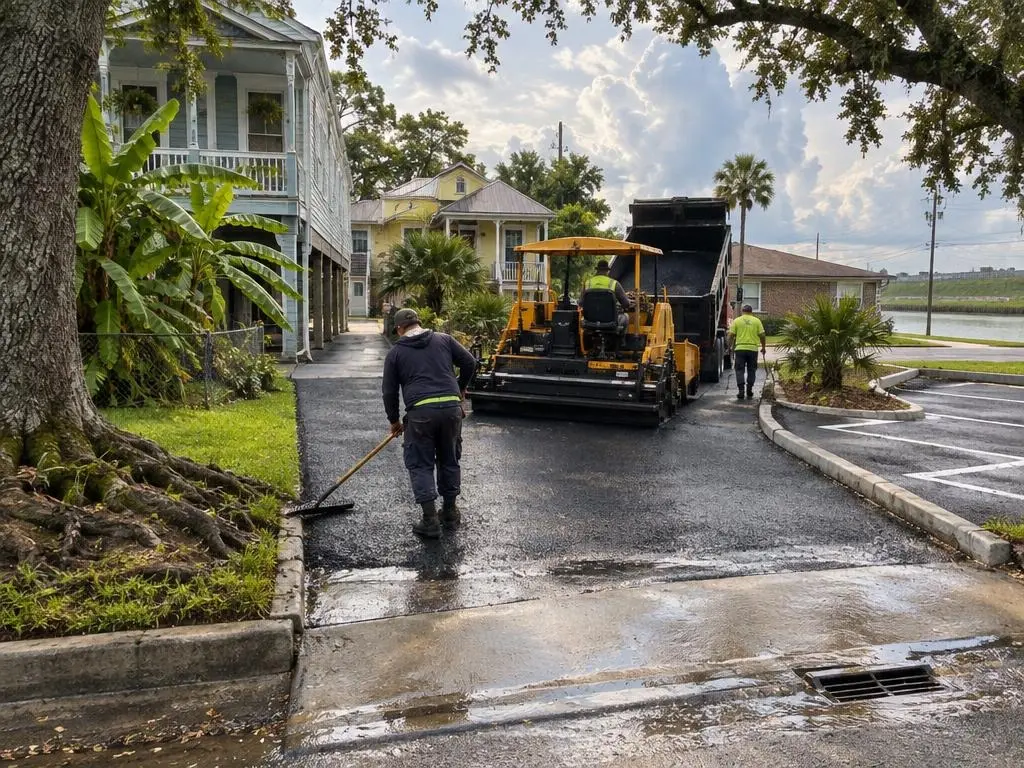
Why Homeowners Call Asphalt Paving New Orleans
Base built for soft ground
Thicker compacted stone, and fabric where needed, so the surface does not sink into wet clay.
Water planned first
Slope set toward drains or planted areas, with low spots corrected before paving.
The right permit office
City, parish or DOTD: we tell you which one applies to your address.
Everything in writing
Removal, base depth, asphalt thickness and drainage work listed and priced, so our bid lines up item by item with other asphalt contractors.
Where We Work
We work throughout New Orleans and the surrounding parishes: Metairie, Kenner, Harahan, River Ridge and Jefferson on the East Bank of Jefferson Parish; Gretna, Harvey, Marrero, Terrytown, Westwego and Estelle on the West Bank; Belle Chasse in Plaquemines; Chalmette, Arabi and Meraux in St. Bernard; Destrehan, St. Rose and Luling in St. Charles; LaPlace in St. John; and Slidell, Mandeville, Covington and Abita Springs on the Northshore. Each area has its own ground conditions and permit office, from the backswamp clays of the East Bank to the higher, sandier ground around Covington. The town pages explain the differences. When you gather bids from paving companies on the Northshore and the South Shore, expect the base plans to differ, since sandier Covington ground may not need the same fabric and stone as a backswamp lot in Metairie.
- Asphalt Paving in New Orleans, LA
- Asphalt Paving in Metairie, LA
- Asphalt Paving in Kenner, LA
- Asphalt Paving in Gretna, LA
- Asphalt Paving in Harahan, LA
- Asphalt Paving in Chalmette, LA
- Asphalt Paving in Slidell, LA
- Asphalt Paving in Marrero, LA
- Asphalt Paving in Harvey, LA
- Asphalt Paving in Westwego, LA
- Asphalt Paving in Terrytown, LA
- Asphalt Paving in River Ridge, LA
- Asphalt Paving in Jefferson, LA
- Asphalt Paving in Belle Chasse, LA
- Asphalt Paving in Arabi, LA
- Asphalt Paving in Mandeville, LA
- Asphalt Paving in Covington, LA
- Asphalt Paving in LaPlace, LA
- Asphalt Paving in Luling, LA
- Asphalt Paving in Destrehan, LA
- Asphalt Paving in Meraux, LA
- Asphalt Paving in Estelle, LA
- Asphalt Paving in Abita Springs, LA
- Asphalt Paving in St. Rose, LA
Common Questions
What is the average cost of asphalt paving for a driveway?
National guides put new asphalt driveways at roughly $5 to $12 or more per square foot (HomeGuide) and $7 to $15 per square foot (Angi). HomeGuide lists a 400-square-foot driveway at $2,000 to $4,800. In New Orleans, a thicker base on soft ground, removal of old pavement and permit work add to that, so we price after seeing the site.
Why is asphalt paving so expensive?
Most of the cost is not the asphalt itself. Removal, hauling, stone base, equipment, crew and hot-mix delivery all add up, and contractors often set a minimum charge; HomeGuide notes some minimums of $2,000 or more. On soft ground, the base work is bigger, which is also what makes the driveway last.
Do I need a permit to repave my driveway in New Orleans?
If the work connects to a public street, yes. The City of New Orleans requires a Driveway or Curb Cut Permit to install, replace or repair a driveway that meets the street, with a $100 application fee. Other parishes and cities have their own rules, and we confirm which applies to your address.
What should paving contractors do differently on New Orleans soil?
Build the base thicker, add fabric where the clay is soft, and set slope toward drains or planted areas so water does not sit on the surface. On an older driveway that has sunk, asphalt repair over the low spot rarely lasts unless the base under it is fixed. If the work meets the street, ask who files the city's Driveway or Curb Cut Permit. An asphalt company that plans all of that before paving is planning for ground below sea level.
Is asphalt or concrete better in New Orleans?
Both are used. Asphalt flexes a little as soft ground moves and is easier to patch, which suits settling soil. Concrete lasts longer but cracks as the ground moves and costs more. City standards require the apron in the public right-of-way to be concrete, so many asphalt driveways meet a concrete apron at the property line.
How long does an asphalt driveway last here?
Cost guides give asphalt driveways about 15 to 30 years. On low, wet ground, how long yours lasts depends on the base, the drainage and whether it is sealed and crack-filled on schedule.
Can I pave my whole front yard for parking?
Usually not. Under the zoning ordinance, most New Orleans neighborhoods limit paving to 40 percent of the front yard. We plan parking pads within those limits.
Get an Asphalt Paving Estimate
Free on-site estimates across Greater New Orleans.